17.11.2026
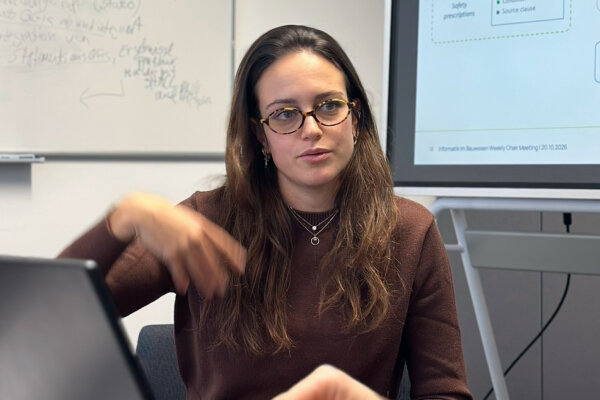
Two months ago, our Chair participated in a roundtable workshop hosted by the Dipartimento ABC at Politecnico di Milano. Now, Federica Madaschi, a PhD Candidate at Polimi, is staying with us for six months as a visiting researcher.
Federica completed her M. Sc. in Building Systems Engineering. Her research leverages Computer Vision as a tool to collect data and information directly from construction sites, with the goal of structuring, analyzing and transforming them into actionable knowledge for safety and operational site management. The aim is to support more reliable, evidence based decision-making processes, rather than relying on perception alone.
In parallel with her doctoral work, she also serves as the PhD Students’ Representative for the DABC, contributing to the scientific and organizational activities of the department.
In our interview, Federica talks about her current research, how her academic career has unfolded, and what she hopes to learn during her visit to our university:
1. What first drew you to the built environment and how did your interests develop into your current research?
My research focuses on safety on construction sites. For the built environment, we are trying to connect documentation and safety requirements to activities on sites, as well as to the original design of a building or infrastructure project. Safety information is usually developed after the design process, so my work explores ways to bring these different sources of information together.
2. Your work uses computer vision to gather information from construction sites. What kinds of challenges can it help address?
My original idea was to use computer vision to extract information from construction site images and connect what is happening on site with the relevant safety documentation and requirements. During my visit, Professor König suggested that I also explore using computer vision to analyze construction-site plans and layouts. So the focus is not only on photographs or videos of the site, but also on drawings and other project documents. So now, computer vision is challenging because I have different applications and ways to use it in order to develop more of my research.
3. As Dipartimento ABC’s PhD Students’ Representative, you contribute to the department’s scientific and organizational life. What would you like to help build for the PhD community?
Being a PhD representative gives me the opportunity to attend monthly meetings with professors and researchers in my department and learn more about the dynamics within it. I can share that knowledge with other PhD students, helping them better understand academic life and career paths in Italy, and consider the choices they may face in the future. I also want students to know they can get in touch with me if they have questions or concerns. We have a WhatsApp community where they can contact me, and I can help them think through possible solutions. I then bring students’ ideas and concerns to the head faculty member who represents the PhD programme, so they can be discussed with the other professors. It’s a complex structure, particularly because Dipartimento ABC has more than 170 PhD students across three or four buildings at Politecnico di Milano. But I hope to make it easier for students to find support and have their voices heard.
4. You have a long-standing background in music and competitive sports. What have those experiences taught you, and do you see them reflected in the way you approach research?
They taught me how to organize my time. Because as a child and teenager, I always had to balance school with sports training and, when I wasn’t training, it was violin practice. That experience has helped me organize my daily routine during my PhD. And I also understood that I needed something to reset my brain, my thinking about the research, so I started training before or after my daily work life in order to find a new point of view or maybe a solution for the question that I didn't resolve in the office that day.
5. What are you hoping to learn or explore during your visit to our university, and what would you like to take back with you to Milan?
Since I have a pure building engineering background, I started to do this PhD in order to merge my bachelor’s and master’s degrees with my interest in computer science, which began in high school. I chose to visit because the work of this Chair closely relates to the topics that inspired me to pursue a PhD and an academic career. I hope to learn as much as I can about computer science, programming and applications of artificial intelligence, and to bring that knowledge back to Italy. I’d also like to share this approach with others there. Work connecting these disciplines is already taking place there, but I hope to contribute to bringing them together in new ways.
We would like to thank Federica for taking the time to do this interview, and are very excited to welcome her to our team!
Copyright © 2026
Last update: Nov 17, 2026