03.08.2026
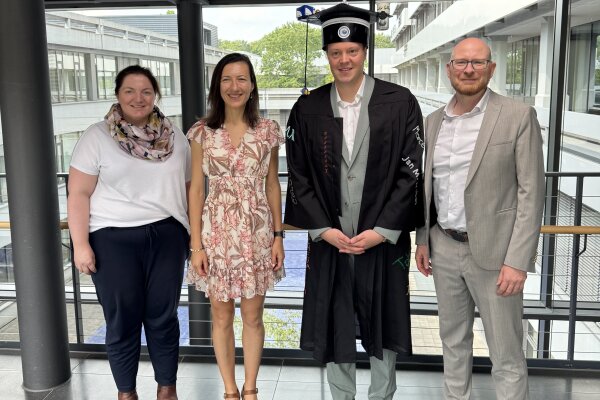
On July 31st, 2026, Benedikt Faltin successfully defended his dissertation titled “Automated Reconstruction of Bridge Superstructure Geometry from Drawings.”
In his research, Faltin focuses on the automated creation of digital bridge models from existing structural documentation. Many bridges in industrialized countries are increasingly aging, a problem that makes efficient, digital planning processes urgently necessary. In his research, he develops a fully automated approach that extracts geometric information from pixel-based construction drawings and uses it to generate digital bridge models. The work analyzes existing methods of drawing analysis, identifies technical limitations of current approaches, combines OCR and deep learning models such as YOLOv8, DETR, as well as Faster R-CNN and validates the results using a comprehensive case study. The result: a reconstructed bridge superstructure with an average deviation of only about eight centimeters compared to a manually created reference model.
Faltin’s approach fills a key data gap in the infrastructure sector and lays the foundation for more efficient, digitally integrated planning and maintenance processes. His research demonstrates how AI-based methods can advance the digitization of existing building documentation - a topic that will continue to gain relevance in the coming years. The dissertation was supervised by Prof. Markus König (Ruhr University Bochum) as the primary advisor and Prof. Yelda Turkan (Oregon State University) as the secondary advisor. Prof. Johanna Waimann (Ruhr University Bochum) chaired the committee.
We congratulate Benedikt Faltin on his achievement and wish him continued success in his future academic and professional endeavors.
On July 31st, 2026, Benedikt Faltin successfully defended his dissertation titled “Automated Reconstruction of Bridge Superstructure Geometry from Drawings.”
In his research, Faltin focuses on the automated creation of digital bridge models from existing structural documentation. Many bridges in industrialized countries are increasingly aging, a problem that makes efficient, digital planning processes urgently necessary. In his research, he develops a fully automated approach that extracts geometric information from pixel-based construction drawings and uses it to generate digital bridge models. The work analyzes existing methods of drawing analysis, identifies technical limitations of current approaches, combines OCR and deep learning models such as YOLOv8, DETR, as well as Faster R-CNN and validates the results using a comprehensive case study. The result: a reconstructed bridge superstructure with an average deviation of only about eight centimeters compared to a manually created reference model.
Faltin’s approach fills a key data gap in the infrastructure sector and lays the foundation for more efficient, digitally integrated planning and maintenance processes. His research demonstrates how AI-based methods can advance the digitization of existing building documentation - a topic that will continue to gain relevance in the coming years. The dissertation was supervised by Prof. Markus König (Ruhr University Bochum) as the primary advisor and Prof. Yelda Turkan (Oregon State University) as the secondary advisor. Prof. Johanna Waimann (Ruhr University Bochum) chaired the committee.
We congratulate Benedikt Faltin on his achievement and wish him continued success in his future academic and professional endeavors.
Copyright © 2026
Last update: Aug 03, 2026